Inferno · US Core · SMART on FHIR
Charles Trinh — ONC g(10) Readiness | Las Vegas, NV · Las Vegas, Nevada · Henderson · Clark County, Nevada · North Las Vegas, Nevada
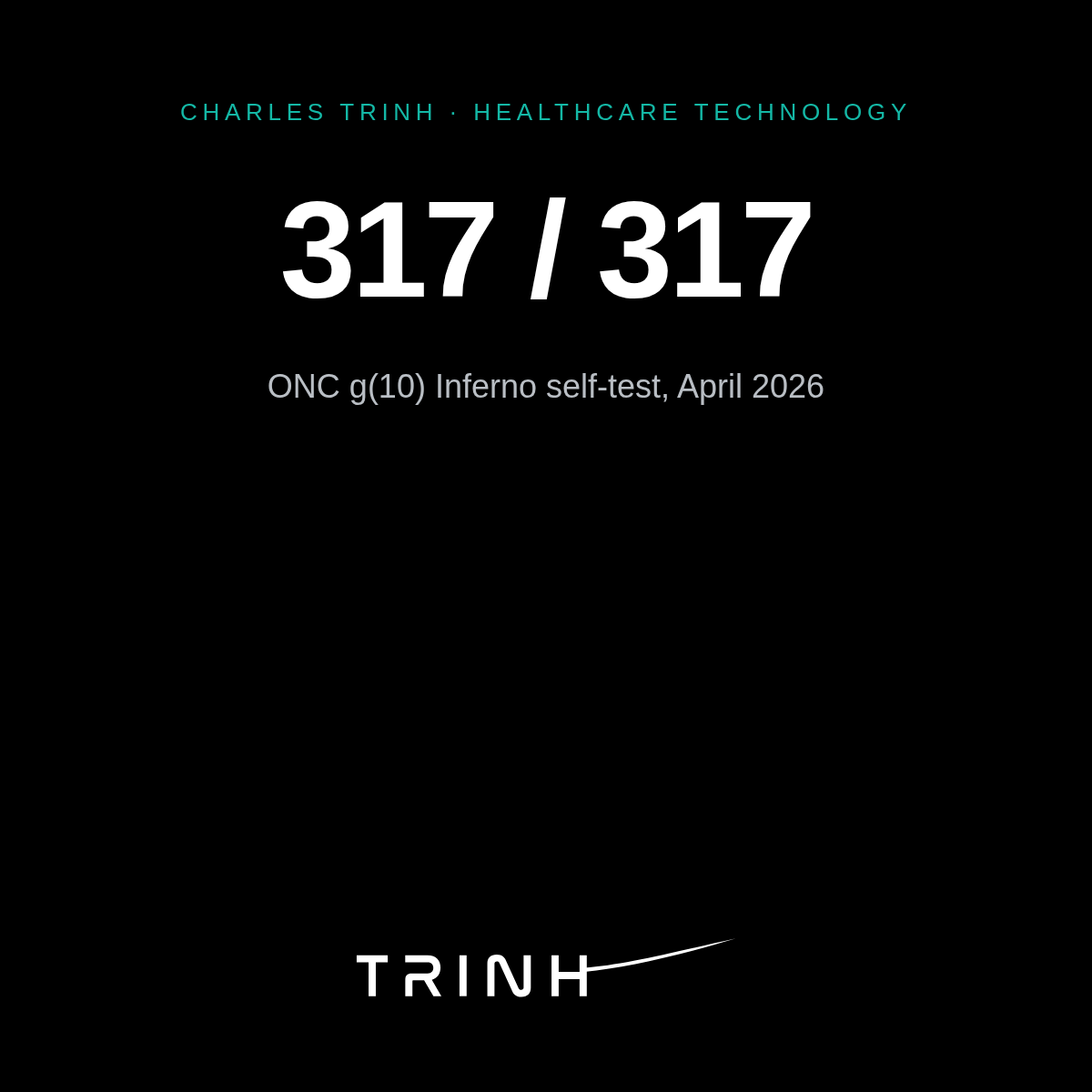
What the ONC (g)(10) suite actually tests, why most teams stall at forty failures, and what a PASS does and does not prove.
What (g)(10) actually requires
The ONC certification criterion known as (g)(10) is the patient and population access requirement inside the 21st Century Cures Act rule. In practical terms it says that a certified health IT module must expose a standards-based API through which a patient — or an authorized third party acting for that patient — can retrieve their own clinical data, and through which a population of patients can be exported in bulk.
Saying that in a product brochure is easy. Demonstrating it is not, because the criterion does not stop at "there is an endpoint." It specifies the resources, the profiles that constrain them, the authorization model in front of them, and the export mechanism behind them. The (g)(10) test suite is the mechanical expression of those requirements: it does not ask whether your API responds, it asks whether it responds correctly to every request a conforming client is entitled to make.
That distinction is where projects lose months. A team builds a FHIR facade, confirms that
/Patient returns a bundle, and considers the work done. The suite then asks for a
patient compartment with includes across multiple resource types, for search parameters that
combine correctly, for an authorization flow that scopes the response to the requesting app,
and for a bulk export that produces a manifest with checksums. Each of those is a separate
requirement, and failing any one of them fails the criterion.
Why teams stall at forty failures
The first run of the suite against a real API almost always produces a long failure list. That list is the single most misunderstood artifact in the project, because it is not a verdict — it is a diagnostic. A team that reads "forty failures" and concludes the work is enormous is reading a number that contains almost no information.
The failures are not forty separate problems. They cluster. Some are one missing element in a profile that cascades across every resource of that type. Some are a single data gap — a patient without a birth date, an observation without a status — that trips every search that touches that record. Some are environmental: a test client that cannot reach the endpoint, a TLS configuration the harness rejects, a certificate the server presents incorrectly. One root cause can produce twenty of the forty, and until you classify them you cannot know which twenty.
This is why the second run matters more than the first. The first run tells you where you are. The second run tells you whether you understand why.
Three classes of failure
Every failure in the list falls into one of three buckets, and the buckets are not interchangeable.
Specification failures are the API doing something the criterion does not permit: a missing must-support element, a search parameter that ignores a modifier, a response that omits the required profile. These are fixed in the implementation, and each fix is verifiable by re-running the specific test rather than the whole suite.
Data failures are the API behaving correctly against data that cannot satisfy the requirement. A patient resource with no identifier, an encounter with no period, a medication list that references a resource the server will not return. These are fixed in the data layer or in the mapping between the source system and the FHIR store, and they are the ones teams underestimate, because the code looks right.
Environment failures are the test harness and the server disagreeing about how to talk: certificate chains, cipher suites, redirects, CORS behaviour, a base URL behind a proxy that rewrites paths. These are the cheapest to fix and the most likely to be mistaken for substantive problems, because the error text describes a failed request rather than a broken requirement.
The order you fix them
Fix the environment first. It costs hours, and it removes noise that would otherwise contaminate every later run. There is no point classifying specification failures against a harness that cannot complete a handshake reliably.
Fix the data second. Data failures cascade: one malformed patient record can fail a dozen tests that are otherwise correct, and fixing the specification first means re-reading the same failures twice.
Fix the specification last, and fix it in dependency order — the authorization layer before the resources it protects, the patient compartment before the searches that traverse it, the bulk export after everything it exports is correct.
Then re-run. Not the individual tests, the whole suite, because the point of a re-run is to confirm that a fix did not break a neighbour. Two engineers fixing two different failures can easily produce a third.
What a PASS proves — and what it does not
A (g)(10) self-test PASS proves that your API, on the date it ran, satisfied every mechanical requirement the reference suite checks. That is a strong claim and it is worth making. My own platform returned 317 of 317 subtests in April 2026, against US Core 6.1.0, USCDI v3, SMART App Launch 2.0.0 and Bulk Data 2.0.0, and the result sits at a stable public URL so that anyone can check it rather than take my word [1][2].
What it does not prove is certification. The (g)(10) suite is a self-service test. Running it does not engage an accredited testing laboratory, does not produce a certification number, and does not put a product on the CHPL. A vendor that describes a self-test PASS as "certified" is either confused or hoping the buyer is. The honest sentence is: we ran the reference suite ourselves and it passed; certification is a separate process with a separate cost.
That honesty is not a weakness in a sales conversation. It is the thing that survives the first technical due-diligence call, where the buyer's engineer will know the difference immediately.
The evidence pack procurement actually wants
When a health system or payer asks for your conformance story, they are not asking for a slide. They want four specific artifacts:
A result that can be checked. A URL to the suite output, not a PDF of a screenshot. If the result is not reproducible by the person reading it, it is not evidence.
The standards, named and versioned. US Core 6.1.0 is a different claim from "US Core." Bulk Data 2.0.0 is a different claim from "bulk export."
The date. A conformance result is a point in time. A suite run from eight months ago against code that has since changed is a historical document, and a careful reviewer will ask what has changed since.
The environment it ran against. Your API, your data, or a sandbox with synthetic patients. The distinction matters to a security reviewer even though the suite does not care.
Assemble those four once and you stop re-litigating conformance on every deal.
Timeline and cost
For an API that already serves FHIR resources, two weeks is a realistic window: a day to stand up the environment and get a clean harness connection, a first full run, a triage pass to classify the failures, then the fix and re-run cycle. The variable is the data layer — a platform whose records are complete and well-identified moves fast; one with messy patient demographics takes longer because every data failure has to be traced to a source.
"Until it passes" means exactly that. The engagement does not end at the failure list. It ends at a run with zero failures, or at a written statement of what remains and why — and if the remainder is a product decision rather than an engineering one, that gets said out loud rather than buried in a document.
Questions worth asking a vendor
Have you run the suite against your own product, and can I see the URL? Which version of each standard did you validate against? What was your first-run failure count, and how many distinct root causes did it represent? What did you do about the failures that were data problems rather than code problems? And: is the result you are showing me a self-test or a certification?
The vendor who answers all five has done the work. The vendor who answers the first one with a slide has not.
The short version
(g)(10) is not a badge you buy. It is a suite you run, a failure list you triage, and a result you publish. The teams that struggle are the ones that treat the first run as a verdict instead of a diagnostic, and the ones that discover — usually in front of a customer — that a self-test PASS and a certification are two different words.
Run it early, run it against real data, and publish the result. It is the cheapest credibility a healthcare API company can buy.
What the suite is actually checking
The g(10) criteria are published and mechanical: a FHIR R4 API with US Core profiles, a SMART authorisation flow, and a Bulk Data export. Inferno sequences them, and its failures name the request that failed and the element that was missing, which makes the work diagnostic rather than interpretive.
The distinction that matters: conformance testing checks integration behaviour, not unit behaviour. A server that returns each resource correctly can still fail every scenario, because the suite tests the sequence a real client performs against a real patient.
That is why the run is most valuable early. In week two a failure is a design input; in month six it is a release blocker with a customer attached to it.
The failure classes worth naming
Missing meta.profile, so the validator cannot tell which profile was intended. Unpinned terminology, so a required binding fails against a value set loaded at the wrong version. A required element left null because the source system never captured it. A search parameter implemented but unindexed. A _include that returns the resource and omits the referenced one.
None are architectural. All are the difference between conformant and useful, and all are cheapest to fix where they are introduced rather than where they are found.
Run the validator in the pipeline on every commit, against real data rather than fixtures, and treat its failures as build failures. A warning everyone has learned to ignore is not a control.
The run is a milestone, not an exam
Schedule the external suite early enough that findings can still change the design. Teams that run it in week two ship in month two, because they discover the shape of the problem while there is still room to move; teams that schedule it as a final gate discover the same things with a customer attached.
Keep the fixtures. A conformance result is a point in time, and the data that passed in March will have changed by June. Rebuilding the run from captured fixtures rather than from a live population is what makes the gate repeatable.
And publish the result. On the date it ran, against which standards, with the URL a stranger can check. A conformance claim without that is a belief, and the engineer across the table will know it.
Proof
- ONC (g)(10) self-test PASS, 317 of 317 subtests, April 2026 — public suite URL
- 67 public hostnames, 51 serving, one AWS account
- 104 clearinghouse enrolments across 53 jurisdictions
- USCDI v7 proposal — Patient Digital Identity Credential — listed at isp.healthit.gov
- SAM.gov UEI MVKQW9DKKGB8 · CAGE 20KM5 · NPI 1194645564
- AWS Business Associate Addendum active since 18 August 2026
Where this work is delivered
Engagements run from Las Vegas and reach across the valley: clients in Las Vegas, NV; Las Vegas, Nevada; Henderson; Clark County, Nevada; and North Las Vegas, Nevada — plus remote delivery nationwide.
How an engagement runs
1. Trace one real case
Follow a single patient or claim end to end with a timestamp at every hop, before any document is written.
2. Written findings
A findings list naming the defect, the system, the owner and the date.
3. Monthly review
Review the list monthly and check whether the dates held.
Frequently asked
What is this service?
This page describes charles trinh — onc g(10) readiness — the scope, the failure modes it prevents and how the work is measured. It sits in the X12 and EDI category at trinh.io.
Where is the work delivered?
Engagements run from Las Vegas, Nevada across the valley — Las Vegas, Henderson, North Las Vegas, Spring Valley, Paradise, Winchester, Sunrise Manor, Enterprise, Summerlin, Clark County — and remotely anywhere in the United States. On-site work in the Las Vegas valley, remote delivery elsewhere.
What does it cost?
Standard rate $195 per hour, committed $165 per hour at twenty hours or more per week for three months or more; $1,600 standard day, $1,350 committed day. Scoped in writing before work starts, fixed fee where the deliverable is defined.
Who is Charles Trinh?
A technology architect in Las Vegas, Nevada, working in healthcare identity, consent and interoperability. Not a physician, not a medical practice, and not affiliated with any other Charles Trinh.
How does an engagement start?
With one trace of a real case and a written findings list naming the defect, the system, the owner and the date. The first call is twenty minutes and free: 702-559-3489.
Engagement
Scoped in writing before work starts; fixed fee where the deliverable is defined. First call is 20 minutes and free. 702-559-3489 · charles@trinh.io
Talk to Charles
- Phone: 702-559-3489
- Email: charles@trinh.io
- Based in Las Vegas, Nevada · working remotely across the United States
Record
Profile
Healthcare technology architect working where federal regulation becomes production infrastructure. Built and operates a FHIR R4 clinical platform — SMART App Launch authorization server, patient and provider portals, SQLite — on a hardened single-host AWS estate of 67 public hostnames. The platform returned a self-test PASS on the ONC (g)(10) Standardized API test suite in April 2026, 317 of 317 subtests, publicly verifiable. Designed a consent architecture in which a permissioned ledger records patient grant, refusal and revocation as immutable events while all clinical data stays off-chain and encrypted per patient — no PHI on the ledger by design. Filed a proposed USCDI v7 data element with ONC on verifiable patient identity. Translates the Federal Register, HHS/CMS guidance and HITRUST requirements into architecture, controls and audit evidence.
Selected engineering scale
- Self-managed estate of 67 public hostnames, 51 serving, on one AWS account.
- FHIR R4 API with a SMART App Launch authorization server; patient and provider portals; an AI service layer; Hyperledger Fabric peer, orderer and CA; IPFS; a 337-table SQLite clinical store.
- Two permissioned distributed ledgers in production, one operating a consent registry that records grant, refusal and revocation with no PHI on chain.
- X12 005010 pipelines across eight transaction sets.
- Designed, built, deployed and operated end to end by one person.
Credentials and standards work
- Inferno (g)(10) self-test PASS, 317 of 317 subtests, April 2026 — the ONC Standardized API test suite. Standards validated: US Core 6.1.0, USCDI v3, SMART App Launch 2.0.0, Bulk Data 2.0.0. Public suite URL.
- USCDI v7 public comment submission, April 2026 — proposed Patient Digital Identity Credential under the Provenance data class, listed publicly on the ONC Interoperability Standards Platform.
- SAM.gov UEI MVKQW9DKKGB8 · CAGE 20KM5 · NPI 1194645564. AWS Business Associate Addendum active 18 August 2026.
Technical environment
AWS us-east-1 (compute, storage, messaging, SMS, email, voice) · Linux and systemd hardening · nginx · Fabric and EVM ledgers · FHIR R4 · X12 005010 · HL7 · SQLite · self-hosted mail, drive, search and monitoring · Git-based change control and CI release gates.

